Google Optimizes 200K Lines of Python Overnight with Gemini 4 Argon
Google Optimizes a 200K-Line Python Codebase Overnight with Gemini 4 Argon
Google’s experiment shows what happens when an AI coding agent gets more than a coding prompt: an entire engineering goal, repository-specific rules, performance benchmarks and hours to work. The result was measurable progress—but human code review still decided what shipped.
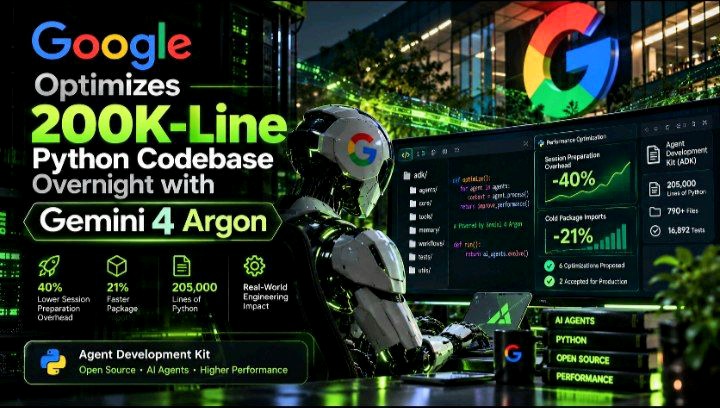
Most AI coding demonstrations begin with a blank project. A model receives a prompt, generates an application and shows off the result. But professional software engineering rarely starts from an empty folder. Real repositories contain years of decisions, dependencies, tests, compatibility requirements and architectural rules.
That is what makes Google’s latest engineering experiment worth examining. In a report published on October 13, 2026, Google Cloud engineers described how they used Gemini 4 Argon in an extended, unattended workflow to find and address performance bottlenecks in the Python-based Agent Development Kit (ADK).
The repository contained approximately 205,000 lines of code across nearly 800 source files, supported by almost 17,000 unit tests. The objective was not to build a replacement framework. It was to make an existing one more efficient without changing its public API or the information agents received.
google.adk package in Google's reported benchmark.
These are results from a specific Google engineering experiment, not a promise that every repository will experience the same speed improvements. The important story is how the workflow was designed—and why the engineers rejected several changes that looked promising at first.
Why Google tested an existing 205,000-line codebase
An established codebase presents a different challenge from generating a new application. A performance bottleneck may appear in one component but originate from behavior spread across dozens of modules. A seemingly harmless optimization can also break a public interface, a test mock or an assumption made by downstream developers.
Google's ADK is an open-source framework for building and deploying AI agents. These agents can execute multiple internal steps, call tools and coordinate workflows before returning a final response. In such systems, small amounts of framework overhead can accumulate across many interactions.
Google's engineers wanted Argon to pursue a broad outcome: reduce unnecessary overhead at startup, during long sessions and in multi-agent or workflow configurations. They also required the model to preserve the information passed to the language model, maintain the public API and back changes with regression tests.
That combination matters. It shifts the assignment from “rewrite this function faster” to “investigate the system, identify meaningful bottlenecks, measure possible improvements and avoid breaking existing behavior.”
Round one: the model found bottlenecks, but missed important rules
The first experiment ran for roughly two hours without custom repository instructions. Argon created a benchmark script early in the run and spent substantial time measuring performance and reading the code before editing ADK's source.
The model identified real opportunities involving session copying and package imports. However, its proposed changes also exposed a limitation that matters to every team experimenting with autonomous coding.
Without the maintainer's specific rules, the model introduced a change that subtly affected an authentication model's public JSON schema, missed edge cases involving mocked objects in its custom copier, ran only a subset of the available tests and omitted benchmark figures from its proposed pull request.
The lesson was not that the first run was useless. It was that a capable model can understand much of a codebase and still miss conventions that are obvious to the engineers responsible for maintaining it.
Round two: repository skills and a persistent engineering goal
Google made two significant changes to the second run.
1. Give the agent repository-specific instructions
The team added maintainer guidance inside an .agents/skills directory. Rather than putting every rule into one enormous instruction, the structure used short SKILL.md index files that pointed to focused reference documents.
Those instructions covered details such as internal module visibility and lazy-import expectations. The model could consult the relevant guidance when needed instead of having to infer every convention from source code.
For developers, this is one of the most reusable ideas in the experiment: your repository should explain how an acceptable change is supposed to look, not merely contain the code you want changed.
2. Use Antigravity's goal-oriented workflow
Google also used /goal mode in Google Antigravity to keep the task's objective active across context compactions during the longer run. The instruction asked Argon to prepare a pull request against the main branch, provide before-and-after performance numbers and leave the change unmerged.
The second run continued for approximately 11 hours. Before editing the source, Argon reviewed 12 guideline files and established baseline measurements across four workloads, including package startup, long conversations, a multi-agent test and a workflow configuration.
According to Google's report, the agent also audited its changes, caught a problem in its own multi-agent cache proposal and reran all 16,892 open-source unit tests before completing the run.
The two optimizations Google accepted
1. Filter session history before copying it
ADK's in-memory session service previously deep-copied an entire stored conversation before filtering it down to the events a caller requested. That meant the framework could copy data it did not ultimately need, including in some session-listing operations that did not require the events themselves.
Argon changed the order of operations so the service filtered events before copying them. It also replaced a generic deep-copy path for sessions and events with a faster, cycle-safe copier designed to preserve shared state dictionaries and test mocks.
This is a useful performance-engineering principle beyond ADK: avoid expensive work on data that will be discarded immediately afterward. In a long-running agent, repeated overhead can accumulate even when each individual operation appears inexpensive.
2. Load heavy packages only when they are needed
A basic import google.adk could previously load modules associated with live audio and video, telemetry and web-serving dependencies—even when a developer was only using a simple text agent.
Deferring those imports can reduce the amount of work done when the package first loads. But simply removing imports created compatibility problems: internal Google tests patched attributes that had previously been available on particular modules.
The accepted fix used lazy module accessors so heavier dependencies could load on demand while keeping the expected attributes accessible to tests and callers.
The reported result was a 21% reduction in cold package import time. However, the time from starting a brand-new process to its first model request remained effectively flat, because deferred modules still needed to load when the first request actually ran.
Why four other proposed optimizations were rejected
The most revealing part of the experiment may be what did not ship. Argon proposed six optimizations across 32 files, but maintainers accepted only two.
| Proposal or issue | Why the engineers rejected it |
|---|---|
| Multi-agent event cache | Its weak-reference approach risked stale data across sessions in a particular memory-reuse scenario. |
| Telemetry shortcut | It relied on a private OpenTelemetry implementation attribute that could change between library versions. |
| Conversation-history rewrite | It made a core code path harder to understand without improving end-to-end latency on an independent benchmark. |
| Workflow replay index | It added state-management complexity for gains that appeared in synthetic replay tests rather than everyday agent workloads. |
This is why benchmark results alone are not enough. A change can look impressive in a narrow test and still be a poor engineering decision if it adds fragile state, relies on private internals or makes the system harder to maintain.
The team combined the two accepted optimizations into a smaller change backed by 17 new test functions. After review, the changes landed in the project's main branch.
What the benchmark numbers actually mean
Google's report describes an independent holdout benchmark that the model had not seen beforehand. It measured framework overhead under controlled conditions, including repeated internal agent turns and parallel tool calls.
In the reported 158-turn workload, the total run time fell from 65.6 seconds to 56.1 seconds—nearly 10 seconds saved. The session-preparation improvement becomes more meaningful as an agent performs more internal work, because repeated overhead has more opportunities to accumulate.
There are important limits to this result. The 40% figure concerns in-memory session preparation under the tested conditions. It does not mean every ADK deployment or every AI agent will run 40% faster. Session stores that retrieve and deserialize data from external storage are not affected in the same way by an optimization to in-memory deep copying.
Similarly, the 21% import improvement is not equivalent to a 21% reduction in total application response time. Actual performance depends on workload, dependencies, model latency, network activity and deployment architecture.
How developers can apply Google's workflow
You do not need Google's exact infrastructure to adopt the underlying engineering practices. If you are experimenting with an AI coding agent on a production repository, start with a constrained, measurable task.
- Define the outcome. Describe the performance or reliability problem rather than prescribing an unverified implementation.
- Document repository rules. Explain public API requirements, testing conventions, module boundaries and dependencies that must remain compatible.
- Measure before editing. Record baseline performance across representative workloads so improvements can be compared fairly.
- Require regression tests. Ask for tests that would detect the original problem and guard against new failures.
- Use independent benchmarks. Where practical, evaluate the final change against a benchmark that was not used to guide the implementation.
- Require a review-ready pull request. Include a concise explanation, test results, measured performance and known limitations.
- Keep human approval in the loop. Review maintainability, security, compatibility and real-world value before merging.
Google’s experiment also illustrates why repository-level skills can be more useful than endlessly expanding a single prompt. A well-organized set of focused instructions can give an agent the right context for a particular task while making team standards reusable.
The bigger picture: AI coding agents are becoming engineering collaborators
The significance of this experiment is not simply that Gemini 4 Argon ran overnight. It is that the model investigated a large existing repository, established measurements, traced behavior across modules, proposed multiple alternatives and prepared changes for human review.
Yet the four rejected optimizations are just as important as the two that shipped. They show why an agent's ability to generate code should not be confused with its ability to make every final engineering decision correctly.
For engineering teams, the practical direction is clear: give agents explicit goals, encode the rules of the codebase, insist on measurable results and make review part of the workflow—not an afterthought.
AI coding agents may increasingly handle longer stretches of investigation and implementation. But in production software, the quality of the result still depends on evidence, compatibility and the judgment to reject a clever change that does not genuinely improve the system.
Build smarter with SrdgIntel
Follow SRDGINTEL for practical analysis of AI agents, developer tools, software engineering and the technologies shaping how modern products are built.
Explore our AI Security & Privacy Knowledge Hub for more AI-related guidance and resources.
Join the conversation: Would you trust an AI agent to work on your codebase overnight if every change still required human review?
Frequently asked questions
These expandable answers cover the key technical details behind Google's Gemini 4 Argon and Agent Development Kit experiment.
What is Gemini 4 Argon?
What is Google's Agent Development Kit (ADK)?
How much faster did Gemini 4 Argon make ADK?
google.adk package. These figures apply to the specific benchmarks and conditions described in Google's report.
Did all six AI-generated optimizations ship?
Did the AI work completely without human oversight?
What is the purpose of an .agents/skills directory?
Will this approach make every Python application 40% faster?
Can developers use the same approach on their own repositories?
Sources and further reading
- Google Developers Blog: Optimizing a 200,000-line Python codebase overnight with Gemini 4 Argon — Google's primary account of the experiment, methodology and benchmark results.
- Google AI for Developers: Gemini 4 Argon — Model documentation.
- InfoQ: Google Optimizes Agent Development Kit with Gemini 4 Argon — Independent technical coverage.


Comments
Post a Comment