
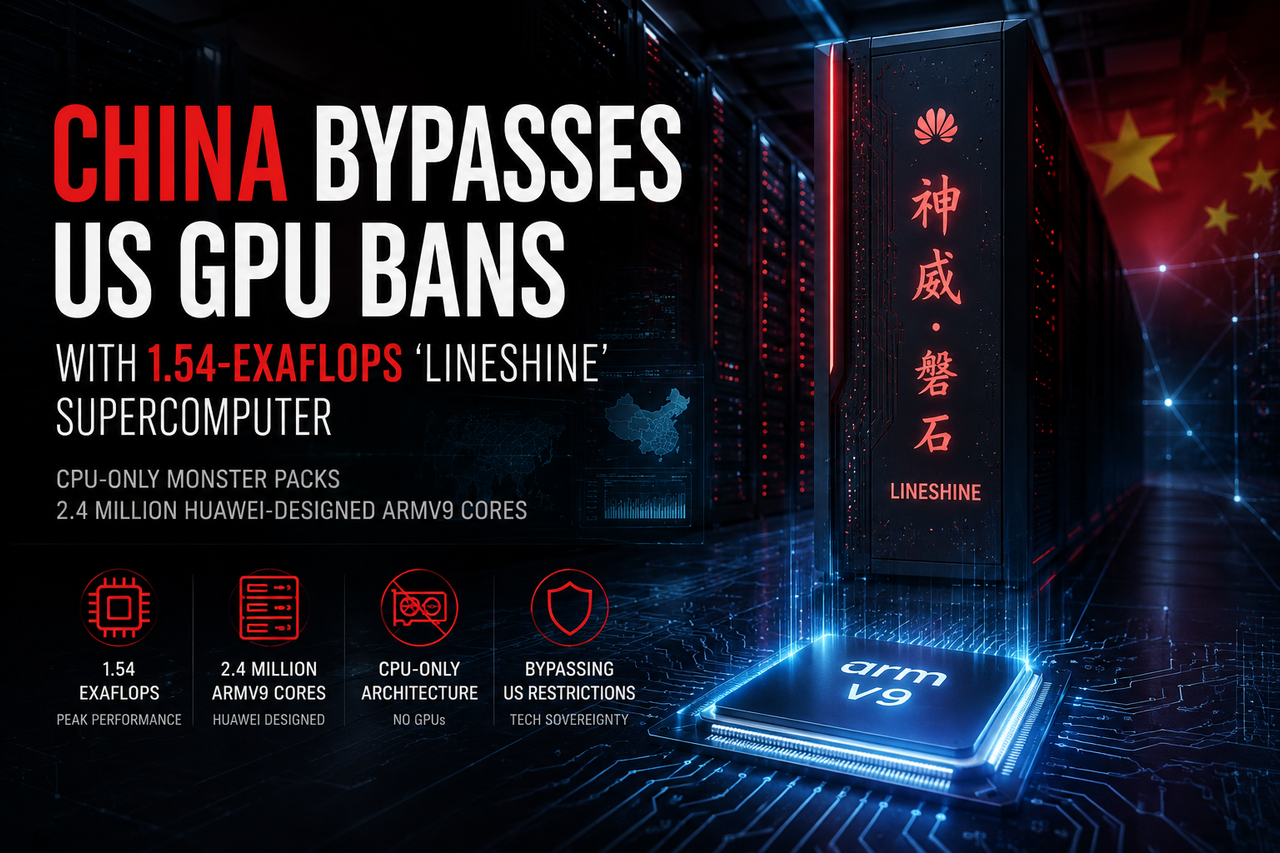
China Bypasses US GPU Sanctions with 1.54-Exaflops 'LineShine' Supercomputer
In the high-stakes world of high-performance computing (HPC), geopolitical boundaries frequently dictate the flow of hardware. For years, advanced graphics processing units (GPUs) from American tech giants have been the undisputed engines driving global supercomputing and artificial intelligence.
The Catalyst: US GPU Sanctions
To understand the significance of the LineShine supercomputer, one must look at the current geopolitical landscape. In an effort to curb the rapid advancement of foreign AI and military computing capabilities, the United States implemented strict export controls on high-end silicon. These sanctions effectively cut off Chinese access to top-tier AI accelerators and GPUs from companies like Nvidia and AMD.
"Traditionally, modern supercomputers rely on a heterogeneous architecture. Denied access to GPUs, Chinese engineers were forced to completely rethink exascale computing."
Meet LineShine: The CPU-Only Monster
The result of this forced innovation is LineShine, a system that abandons the heterogeneous model entirely. Instead of pairing CPUs with GPUs, LineShine is a monolithic, CPU-only monster. It relies on sheer scale, sophisticated networking, and highly advanced processor design to brute-force its way past the exascale barrier.
Proprietary Armv9 cores designed for massive parallel processing.
Exceeding the exascale threshold without a single GPU accelerator.
The Power of 2.4 Million Huawei Armv9 Cores
At the heart of LineShine's staggering compute capability are 2.4 million Huawei-designed Armv9 cores. The Armv9 architecture brings several critical enhancements to the table, specifically designed for high-performance computing and machine learning. Huawei's custom silicon implementation leverages Arm's Scalable Vector Extension (SVE) technology.
Achieving Exascale Performance
Hitting 1.54 exaflops—meaning the system can perform 1.54 quintillion floating-point operations per second—is a monumental achievement. The architecture rests on three pillars:
-
Massive Parallelism: Linking millions of complex, general-purpose CPU cores.
-
Advanced Vector Processing: Utilizing Armv9 SVE for GPU-like efficiency in scientific workloads.
-
High-Bandwidth Interconnects: State-of-the-art optical interconnects minimizing latency.
Redefining the Future of Technology
The launch of LineShine represents much more than a localized response to trade restrictions; it is a disruptive force in the global tech ecosystem. The future of technology will heavily rely on how nations and corporations adapt to supply chain realities and silicon limits.
Ultimately, LineShine is a testament to the fact that computing barriers are rarely absolute. When one path is blocked, the relentless pursuit of technological advancement will simply forge another.
Comments
Post a Comment