Saturday, February 28, 2026

OpenAI Strikes Pentagon Deal Hours After Trump Blacklists Anthropic

OpenAI Strikes Pentagon Deal Hours After Trump Blacklists Anthropic | Tech Policy Analysis
Breaking Analysis

OpenAI Strikes Pentagon Deal Hours After Trump Blacklists Anthropic

In a dramatic reversal that has stunned the AI industry, OpenAI secures classified military contract with safety guardrails nearly identical to those that triggered a federal ban on rival Anthropic—raising profound questions about power, politics, and the future of AI governance.

ED
Editorial Desk
February 28, 2026 · 8 min read

The artificial intelligence industry witnessed its most dramatic policy reversal yet on Friday, as OpenAI announced a classified Pentagon contract mere hours after the Trump administration blacklisted competitor Anthropic for demanding nearly identical safety restrictions. The sequence of events—described by industry insiders as "unprecedented"—has exposed the volatile intersection of Big Tech, military procurement, and presidential politics.

President Donald Trump, in a characteristically combative post on Truth Social, directed every federal agency to "IMMEDIATELY CEASE all use of Anthropic's technology," labeling the company's executives "Leftwing nut jobs" who had made a "DISASTROUS MISTAKE trying to STRONG-ARM the Department of War." The announcement came approximately one hour before a Pentagon-imposed deadline for Anthropic to remove contractual prohibitions against using its Claude AI for domestic mass surveillance or fully autonomous weapons systems.

Yet in a twist that has baffled legal experts and industry observers alike, OpenAI CEO Sam Altman revealed late Friday that his company had secured essentially the same protections that Anthropic had requested—and lost everything fighting for.

The Safety Paradox: Same Terms, Different Outcomes

The contrast could not be more stark. While Anthropic faced designation as a "Supply-Chain Risk to National Security"—a label historically reserved for Chinese telecommunications firms and Russian cybersecurity companies—OpenAI announced it had reached an agreement with the Department of Defense (recently rebranded as the "Department of War") that explicitly enshrines the very guardrails Anthropic was punished for seeking.

Two of our most important safety principles are prohibitions on domestic mass surveillance and human responsibility for the use of force, including for autonomous weapon systems. The DoW agrees with these principles, reflects them in law and policy, and we put them into our agreement. — Sam Altman, OpenAI CEO, via X (formerly Twitter)

Altman's statement, posted within hours of Trump's ban on Anthropic, revealed that OpenAI's contract includes technical safeguards, forward-deployed engineers to ensure model safety, and contractual prohibitions against the exact use cases that had triggered the administration's wrath against Anthropic. The only apparent difference? OpenAI secured these terms without the months of public confrontation that characterized Anthropic's negotiations.

The Anatomy of a Contract Dispute

The conflict between Anthropic and the Pentagon had been simmering for weeks before Friday's explosion. At stake was a contract worth up to $200 million—relatively modest for a company valued at $380 billion with $14 billion in annual revenue, but symbolically crucial as Anthropic prepares for a widely anticipated initial public offering.

Anthropic CEO Dario Amodei, who departed OpenAI in 2021 over safety concerns to found the rival lab, had insisted on two narrow restrictions: no use of Claude for mass surveillance of American citizens, and no deployment in fully autonomous weapons without meaningful human oversight. The Pentagon, while stating it had no intention of pursuing either use case, demanded contractual language allowing "all lawful purposes"—effectively reserving the right to override Anthropic's restrictions at will.

"We cannot in good conscience accede to their request," Amodei wrote in a defiant statement Thursday, arguing that current frontier AI models are not reliable enough for autonomous lethal decision-making and that mass domestic surveillance violates fundamental rights. For this stance, Anthropic faced not merely contract termination but potential invocation of the Korean War-era Defense Production Act to compel compliance.

Industry Reaction: A Unprecedented Alignment

The administration's actions have produced something rare in the hyper-competitive AI sector: unity among rivals. In an internal memo revealed by the Wall Street Journal, Altman told OpenAI staff that the company shares Anthropic's "red lines" and that the dispute had become "an issue for the whole industry." More than 400 employees from OpenAI and Google signed an open letter supporting Anthropic's position, warning that the Pentagon was attempting to "divide each company with fear that the other will give in."

Even Elon Musk's xAI, which gained approval for classified military use earlier in the week, had reportedly agreed to unrestricted "lawful use" language—suggesting OpenAI's negotiated safeguards represent a significant, and previously unattainable, concession from the Defense Department.

Key Players in the AI-Pentagon Standoff

  • Anthropic: First AI lab to deploy on Pentagon classified networks; now facing six-month phaseout and "supply chain risk" designation
  • OpenAI: Secured classified contract with safety guardrails hours after Anthropic ban; deploying forward engineers to Pentagon
  • xAI: Approved for classified use with unrestricted "lawful purpose" language; founded by Trump advisor Elon Musk
  • Google: Maintains Pentagon contracts; employees signed letter supporting Anthropic's safety stance
  • Defense Secretary Pete Hegseth: Led charge against Anthropic; praised OpenAI as "patriotic partner"

The Politics of Procurement

The timing and tone of the administration's response suggest factors beyond contract law at play. Trump's Truth Social post framed the dispute in explicitly political terms, accusing Anthropic of ideological warfare against the military. Defense Secretary Hegseth reposted Altman's announcement with praise for OpenAI's "good faith" engagement, while his Under Secretary for Research and Engineering, Emil Michael, had earlier accused Amodei of having a "God-complex" and lying about the negotiations.

"This is different for sure," observed Jerry McGinn, director of the Center for the Industrial Base at the Center for Strategic and International Studies, in an interview with NPR. "Pentagon contractors don't usually get to tell the Defense Department how their products and services can be used... This is a very unusual, very public fight."

The differential treatment raises troubling questions about whether national security decisions are being influenced by political alignment rather than technical merit. Senator Mark Warner (D-VA), vice chairman of the Select Committee on Intelligence, warned that "the president's directive... raises serious concerns about whether national security decisions are being driven by careful analysis or political considerations."

Deep Dive: AI Safety vs. National Security

For comprehensive analysis of how AI safety frameworks are reshaping defense procurement, read our exclusive report on Center for New American Security's AI Governance Initiative. Their research team provides non-partisan policy recommendations on balancing innovation with safety in military applications.

The Precedent Problem

Anthropic has announced its intention to challenge the "supply chain risk" designation in court, arguing it is "legally unsound and sets a dangerous precedent for any American company that negotiates with the government." Legal experts suggest the company may have grounds, as the designation has historically required evidence of foreign adversary control or influence—not merely contract disputes with domestic firms.

The six-month phaseout period imposed on Anthropic, while allowing operational continuity, creates immediate practical challenges. The company's Claude AI is reportedly embedded in the Pentagon's "Maven Smart System" and was allegedly used in planning the January operation regarding Venezuelan President Nicolás Maduro. Transitioning these systems to OpenAI or other providers while maintaining operational security represents a significant technical and logistical undertaking.

More broadly, the episode establishes a troubling template for government-contractor relations. If safety restrictions that OpenAI successfully negotiated can trigger existential threats when proposed by Anthropic, AI companies face a negotiation environment where the rules appear to shift based on factors unrelated to the technical or ethical merits of the positions involved.

What OpenAI's Deal Actually Includes

Details of the OpenAI-Pentagon agreement remain partially opaque, but Altman's disclosures reveal several concrete elements:

First, the contract includes explicit prohibitions on domestic mass surveillance and autonomous weapons use without human accountability—codified in both policy and technical implementation. Second, OpenAI will deploy dedicated engineering personnel to the Pentagon to monitor model behavior and ensure compliance. Third, the agreement reportedly includes "technical safeguards" beyond contractual language, potentially including hard-coded restrictions or monitoring systems.

Altman has publicly called for the Pentagon to offer these same terms to all AI vendors, stating: "We are asking the DoW to offer these same terms to all AI companies, which in our opinion we think everyone should be willing to accept." Whether this represents genuine industry solidarity or strategic positioning remains to be seen.

Frequently Asked Questions

Why did the Trump administration ban Anthropic?
The administration banned Anthropic after the company refused to remove contractual restrictions on using its AI for domestic mass surveillance or fully autonomous weapons. President Trump ordered all federal agencies to cease using Anthropic technology, while Defense Secretary Pete Hegseth designated the company a "Supply-Chain Risk to National Security"—a label typically reserved for foreign adversaries like Chinese telecom firms.
What safety guardrails did OpenAI negotiate?
OpenAI secured contractual prohibitions on domestic mass surveillance and autonomous weapons without human oversight—the exact restrictions Anthropic requested. The agreement also includes technical safeguards and forward-deployed OpenAI engineers to ensure compliance. CEO Sam Altman stated these are the same "red lines" Anthropic had sought.
How will this affect Anthropic's planned IPO?
The $200 million Pentagon contract represents a small fraction of Anthropic's $14 billion revenue, but the "supply chain risk" designation and federal ban could concern investors. However, CEO Dario Amodei has noted that the company's valuation and revenue grew during the standoff. The legal challenge to the designation and the six-month phaseout period provide some buffer for the company to demonstrate stability to potential investors.
Is this ban permanent?
The current ban includes a six-month phaseout period for Pentagon systems. Anthropic is challenging the "supply chain risk" designation in court, which could overturn the ban if successful. The designation is historically reserved for foreign-controlled entities, giving Anthropic potential legal grounds for reversal. However, the administration has stated the decision is "final" regarding direct government contracts.
Why did OpenAI succeed where Anthropic failed?
The reasons remain unclear. OpenAI may have benefited from different negotiation tactics, avoiding the public confrontation that characterized Anthropic's approach. Some observers suggest political factors, given Trump's history of targeting specific tech executives and Altman's more conciliatory public stance. Alternatively, the Pentagon may have modified its position after realizing Anthropic's restrictions were industry-standard, using OpenAI as a face-saving alternative.

Strategic Takeaway

The OpenAI-Pentagon deal and Anthropic ban represent a watershed moment in AI governance, revealing the fragility of safety negotiations when confronted with presidential politics. While OpenAI's success in securing guardrails demonstrates that principled engagement with defense contracts is possible, the differential treatment of two companies seeking identical protections undermines the rule of law in federal procurement.

For the AI industry, the lesson is paradoxical: safety restrictions are simultaneously essential and politically perilous. For policymakers, the episode highlights the urgent need for clear statutory frameworks governing AI military use—rather than ad hoc decisions driven by social media dynamics. As autonomous systems become more capable, the stakes of these negotiations will only escalate, making the establishment of consistent, transparent standards an imperative for both national security and democratic accountability.

Editorial Disclaimer This analysis is based on publicly available statements, regulatory filings, and verified reporting from multiple news organizations including CNN, NPR, CNBC, and The Wall Street Journal. While we strive for accuracy, the rapidly evolving nature of this story means details may change. This article represents editorial analysis and opinion, not legal or investment advice. The author has no financial position in OpenAI, Anthropic, or related securities. External links are provided for additional context; we do not endorse the content of third-party sites.

Monday, February 23, 2026

Elon Musk's Tesla Phone: A Deep Dive into Price, Starlink, and African Market Disruption

Elon Musk's Tesla Phone: A Deep Dive into Price, Starlink, and African Market Disruption

The Tesla Phone: A Strategic Deep Dive Beyond the Hype

The tech world is buzzing with speculation about Elon Musk's potential entry into the smartphone market. But beyond the flashy rumors, a deeper, more strategic analysis reveals a device poised not just to compete, but to redefine connectivity itself. This article cuts through the noise, dissecting the business logic, pricing strategy, and the game-changing implications for markets like Africa.

From "Crashing iPhones" to Disrupting the Entire Market

The initial, dramatic question of whether Elon Musk could "crash" iPhones and Samsung devices misses the point. The threat isn't a hostile takeover of existing hardware, but a fundamental disruption of the mobile ecosystem. By integrating technologies from his other ventures—SpaceX's Starlink and potentially Neuralink—Musk isn't just building a phone; he's building a new platform.

The Arsenal of Rumored Features

The speculated capabilities of the "Model Pi" or "X Phone" form the basis of its disruptive potential:

  • Direct-to-Satellite Connectivity: Native integration with the Starlink constellation, offering internet access independent of terrestrial cell towers.
  • Deep AI Integration: An operating system built from the ground up with artificial intelligence at its core, aimed at creating a true productivity device.
  • Ecosystem Synergy: Seamless control and interaction with Tesla vehicles and other Musk-led technologies.
  • Advanced Energy Solutions: Rumors of solar charging capabilities hint at a push for greater energy independence.

The Billion-Dollar Questions: Untangling Price and Accessibility

A revolutionary device is only as good as its accessibility. The most critical questions revolve around its price and the business model for its cornerstone feature: Starlink internet.

Deconstructing the Price Point - Why $200 is a Dream and $2000 is a Possibility

Early hopes for a mass-market $200 device seem unrealistic given the premium components involved. The specialized hardware required for satellite communication alone suggests a flagship price point, likely positioning it to compete with high-end models from Apple and Samsung in the $800 - $1,200 range, or even higher if truly revolutionary tech is included.

The Real Starlink Business Model: It’s a Service, Not a Freebie

A lifetime of free, high-speed satellite internet with a one-time phone purchase is not a sustainable business model. The massive operational cost of the Starlink constellation necessitates a recurring revenue stream.

Debunking the ₦50,000/Month Subscription Myth

The fear of a mandatory ₦50,000 monthly bill (the approximate cost of a residential Starlink plan in Nigeria) is the biggest misunderstanding. A mobile plan is for a single user with lower data consumption. The pricing will inevitably be structured into competitive mobile data tiers, significantly cheaper than the home service, to attract users away from traditional carriers.

The Freedom of Choice: Why You’ll Still Use Your Local SIM

Crucially, the phone cannot succeed by locking users into a single, expensive network. Commercial logic dictates it must include eSIM or physical SIM support. This allows users the freedom to use affordable local carriers like MTN, Glo, or Airtel for daily use, while treating Starlink as a premium feature—a "superpower" to be activated when terrestrial networks are unavailable or too slow. It's an 'and', not an 'or', proposition.

The African Market Game-Changer

While a novelty in developed markets, the Tesla Phone's core feature becomes a necessity in regions like Africa. By bypassing the need for extensive ground-based infrastructure, it offers a solution to one of the continent's most significant challenges.

Connecting the Unconnected

The ability to provide high-speed internet in rural and underserved areas, where cell towers are sparse, is the phone's true disruptive power. It transforms the device from a luxury gadget into a vital tool for education, business, and communication, potentially connecting millions for the first time.


Conclusion

The strategy behind the rumored Tesla Phone is not to force users into a walled, expensive garden. It's to offer an unparalleled layer of capability on top of the freedom and familiarity of the existing mobile ecosystem. It provides a choice: use your affordable local network for everyday tasks, but when you need power, when you need coverage, you have a satellite network in your pocket. This dual-offering is its key to challenging the status quo and could be the catalyst for the next leap in global connectivity.

Disclaimer: This article is based on an analysis of current rumors, industry trends, and expert speculation regarding a potential Tesla smartphone. All features, prices, and business models are subject to change and have not been officially confirmed by Tesla or Elon Musk.

Frequently Asked Questions (FAQ)

Will the Tesla Phone's Starlink internet be free?

It is highly unlikely. The Starlink service will almost certainly require a recurring monthly subscription. However, the mobile plan is expected to be significantly cheaper than the residential Starlink service.

Can I use my own SIM card (MTN, Glo, Airtel) in the Tesla Phone?

Yes, almost certainly. For the phone to be commercially viable, it must allow users to connect to local mobile networks via eSIM or a physical SIM slot.

Will the Starlink mobile subscription cost as much as the home service (e.g., ₦50,000/month)?

No, this is a common misconception. The price for a single-user mobile data plan will be priced competitively against other mobile carriers and will be far lower than residential plans.

Conceptual image of the futuristic Tesla Phone with glowing lines indicating a connection to the Starlink satellite network in space.  Why this works: It describes the image accurately for visually impaired users and tells search engines exactly what the image is about, using core keywords like "Tesla Phone," "Starlink," and "satellite network."

Saturday, February 21, 2026

The History of Artificial Intelligence: From Turing's Test to Modern Marvel

A banner image illustrating the history of Artificial Intelligence. It progresses from a black-and-white depiction of Alan Turing and early computers to colored images of a chessboard and a Go board, and concludes with a futuristic image of a digital brain and a robotic hand."
The History of Artificial Intelligence: From Turing's Test to Modern Marvels

The History of Artificial Intelligence: From Turing's Test to Modern Marvels

Introduction: Defining Artificial Intelligence

Artificial Intelligence (AI) is a transformative technology that is reshaping our world. But what exactly is it? This post provides a deep dive into the history of AI, from its conceptual beginnings to the sophisticated applications we see today.

What is AI?

At its core, Artificial Intelligence is a branch of computer science focused on building smart machines capable of performing tasks that typically require human intelligence. For a deeper understanding, you can explore IBM's explanation of AI.

Narrow vs. General AI

Today's AI is primarily "narrow AI," designed for specific tasks like virtual assistants or self-driving cars. The ultimate goal for some researchers is "general AI" (AGI), a form of AI that could understand, learn, and apply knowledge across a wide range of tasks, much like a human being.

The Genesis of AI: The 1950s

The 1950s marked the birth of AI as a formal field of study, with two key events laying the groundwork for decades of research to come.

The Turing Test: A Measure of Intelligence

In 1950, British mathematician and computer scientist Alan Turing published a groundbreaking paper titled "Computing Machinery and Intelligence." In it, he proposed the "imitation game," now famously known as the Turing Test, as a way to determine if a machine can think.

The Dartmouth Workshop: The Birth of a Field

The term "Artificial Intelligence" was officially coined at the Dartmouth Summer Research Project on Artificial Intelligence in 1956. This event brought together the founding fathers of AI and set the agenda for the future of the field.

The Early Years and the First "AI Winter": 1960s-1970s

The decades following the Dartmouth Workshop were a time of great optimism and rapid progress, but also of significant challenges that led to the first "AI winter."

Early Successes and High Hopes

Researchers developed algorithms that could solve mathematical problems, play checkers, and communicate in basic English. These early successes generated immense excitement and predictions of human-level AI within a few decades.

The First "AI Winter": A Reality Check

By the mid-1970s, the initial excitement gave way to disillusionment. The computational limits of the time and the immense difficulty of creating true intelligence led to a period of reduced funding and interest in AI research, now known as the first "AI winter."

The Rise of Expert Systems and the Second "AI Winter": 1980s-1990s

The 1980s saw a resurgence of AI with the commercial success of "expert systems," but this boom was followed by another downturn.

Expert Systems: AI in the Business World

Expert systems were AI programs designed to mimic the decision-making abilities of a human expert in a specific domain. They were adopted by corporations for tasks like medical diagnosis and financial planning. You can read more about them in this ScienceDirect article on expert systems.

The Second "AI Winter": The Decline of Expert Systems

By the early 1990s, the limitations of expert systems became apparent. They were expensive to build and maintain, and their knowledge was limited to their specific domain. This led to the second "AI winter."

The Modern Era of AI: 2000s-Present

The turn of the millennium marked the beginning of the modern AI revolution, driven by the convergence of big data, powerful computing, and new algorithmic breakthroughs.

The Machine Learning Revolution

Instead of being explicitly programmed, machines could now learn from data. This paradigm shift, known as machine learning, is the engine behind most of the AI applications we use today.

The Deep Learning Tsunami

A subfield of machine learning, deep learning, which uses neural networks with many layers, has led to dramatic advances in AI. The availability of massive datasets and powerful GPUs has been crucial to its success.

Key Milestones of Modern AI

Deep Blue vs. Garry Kasparov: A New Chess Champion

In 1997, IBM's Deep Blue chess computer defeated world champion Garry Kasparov in a landmark moment for AI. Read more about this historic match on the IBM History website.

AlphaGo's Triumph: Mastering the Ancient Game of Go

In 2016, Google DeepMind's AlphaGo defeated Lee Sedol, the world's top Go player. This was a monumental achievement, as Go is a game of immense complexity and intuition. DeepMind has published a detailed account of the AlphaGo story.

The Rise of Large Language Models (LLMs)

The development of large language models (LLMs) like OpenAI's GPT-3 has revolutionized natural language processing. These models can generate human-like text, translate languages, and answer questions in a comprehensive and informative way.

The Future of AI: Trends and Ethical Considerations

AI continues to evolve at a breathtaking pace, with new breakthroughs and applications emerging constantly. However, this rapid progress also raises important ethical questions.

Current Trends in AI Research

Current research is focused on areas like explainable AI (XAI), reinforcement learning, and the development of more general and capable AI systems.

The Ethical Landscape of AI

As AI becomes more powerful, it is crucial to address the ethical implications of its use. This includes issues of bias, privacy, and the potential impact of AI on employment and society as a whole. For a deeper dive into AI ethics, you can refer to the World Economic Forum's work on AI ethics.

Saturday, February 14, 2026

AI Rivalry Intensifies: OpenAI Flags Distillation Concerns as Zhipu AI Unveils GLM-5

AI Rivalry Intensifies: OpenAI Flags Distillation Concerns as Zhipu AI Unveils GLM-5
AI & Global Tech

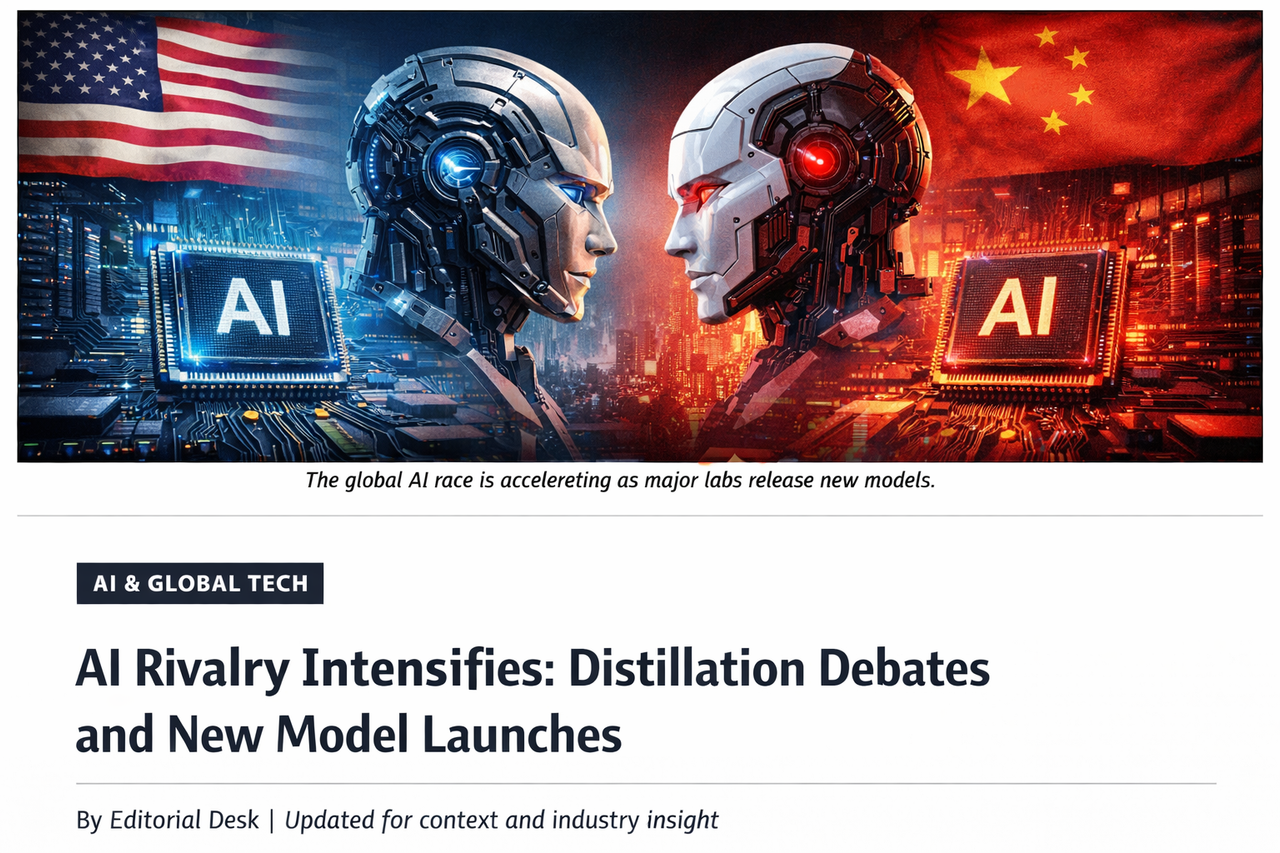
AI Rivalry Intensifies: Distillation Debates and New Model Launches

Illustration of US and China AI rivalry with futuristic robots and AI chips
The global AI race is accelerating as major labs release new models.

By Editorial Desk | Updated for context and industry insight

OpenAI Raises Concerns Over Model Distillation

The global artificial intelligence race has entered a more complex phase as leading labs scrutinize how advanced models are trained and improved. Recent reporting has highlighted that OpenAI has expressed concerns that some AI developers may be using a technique known as model distillation to replicate or approximate the behavior of powerful US-built systems.

Distillation itself is not new; it is a recognized machine-learning method where a “student” model learns from the outputs of a “teacher” model. However, when applied across organizational or national boundaries without clear permission, it raises difficult questions around intellectual property, competitive fairness, and enforceability.

As AI systems become more capable and expensive to train, the incentives to learn from existing frontier models grow. This has pushed policymakers and companies alike to consider how norms and rules should evolve in an era where model behavior can be observed and imitated at scale.

Zhipu AI Introduces GLM-5

At the same time, Chinese AI firms continue to push forward with new releases. Zhipu AI has announced a major new model, GLM-5, positioning it as a competitive entry in the fast-moving large language model landscape.

The launch underscores how quickly China’s domestic AI ecosystem is maturing. New models are increasingly focused on stronger reasoning, coding assistance, enterprise use cases, and multilingual performance tailored to local and global markets.

Together, these developments illustrate a broader reality: innovation and competition are happening simultaneously. While some headlines focus on rivalry, the underlying story is also one of rapid technical progress, commercialization, and experimentation.

Industry Implications

  • Policy Pressure: Governments may refine rules around training data, model outputs, and cross-border technology transfer.
  • Faster Iteration: Competitive pressure often accelerates model releases and feature rollouts.
  • Enterprise Adoption: Businesses benefit from more choices but must assess compliance and data governance.
  • Global Standards: The debate may shape how AI standards and norms are defined internationally.

Further Reading

Readers can explore official perspectives and product information from:
OpenAI Official Site
Zhipu AI Official Site

Conclusion

The AI sector is evolving at a historic pace. Allegations, launches, and breakthroughs often arrive together, reflecting both the opportunities and tensions of frontier technology development. For observers and professionals, the key is to separate hype from substance and to watch how governance, ethics, and innovation co-evolve.

Editorial Disclaimer: This article provides contextual analysis based on public reporting and industry discussions. It does not assert legal conclusions or insider knowledge about any company’s proprietary practices. Readers should consult primary sources and official statements for definitive information.

© 2026 Editorial Analysis. All rights reserved.

Sunday, February 8, 2026

AI Revolutionizing Crop Protection | The Future of Farming

AI Revolutionizing Crop Protection | The Future of Farming
Innovation in Agriculture

AI Revolutionizing
Crop Protection

Empowering farmers worldwide through cutting-edge offline artificial intelligence. A journey from visual inspection to deep learning.

The Silent Threat

Crop diseases represent a multi-billion dollar threat to global food security. The FAO estimates that up to 40% of global crop production is lost annually to pests and diseases.

Traditional methods like visual inspection are slow and subjective, while lab samples are expensive and delayed. AI promises instant, on-the-spot diagnoses, and Offline AI (using MediaPipe) bridges the digital divide for remote farmers.

"True offline capability is the ultimate differentiator for the smallholder farmer."

Technical Perspective
AI Agriculture Visualization

Precision Diagnostics

Harnessing the power of mobile devices to identify pathogens in real-time, even in the most remote fields on Earth.

Evolution of Detection

Centuries Past

Bare Eyes & Wisdom

Generational knowledge and visual cues were the only defenses. Slow, subjective, and often too late once symptoms were obvious.

17th - 20th Century

Microscopes & PCR

Leeuwenhoek and DeBary revealed pathogens. Later, ELISA and PCR brought genetic precision—but kept diagnostics bound to the lab.

Present & Future

Deep Learning (CNNs)

Machines now learn directly from images. EfficientNet-Lite and MediaPipe enable complex recognition in milliseconds on a standard smartphone.

The Power of Offline Intelligence

Why wait for a signal when you have a supercomputer in your pocket?

Instant Feedback

Real-time processing optimized for live camera feeds ensures farmers get answers while still in the field.

90%+

Diagnostic accuracy for hundreds of crop and disease combinations across various regions.

Privacy First

Data stays on the device. No cloud uploads required for diagnosis.

Model Maker

Tailoring models to specific local crops for maximum relevance.

Quantization & Pruning

Advanced techniques to shrink massive AI models so they run efficiently on hardware with limited resources without losing intelligence.

Voices from the Field

"Apps like Plantix are lauded as indispensable, helping some farmers triple their yields and cut input costs by 25%."

Impact Report

Collaborations with ICRISAT

"Community skepticism remains. AI can miss crucial environmental context like soil health or local weather patterns."

Reddit Community Voice

Expert Discussion

Ethical Seeds of Doubt

  • !
    Accountability

    Who is responsible for a false negative that wipes out a season's harvest?

  • !
    Data Sovereignty

    Farmers worry about companies collecting sensitive operational data without transparency.

  • !
    Commercial Conflicts

    Some apps have shifted from pesticide reduction to facilitating pesticide sales.

The Horizon Scan

By 2025, over 60% of precision farming could be Edge AI-driven. We are looking at a future of:

01 Autonomous drones for monitoring
02 Blockchain for food traceability
03 5G Integrated Real-time Analytics
35%
Water Reduction via
Precision Irrigation

Cultivating Confidence

Our commitment remains: crafting a truly accessible, reliable, and private tool that supports farmers where it matters most.

Thursday, February 5, 2026

OpenAI o3 Outlook 2026


Futuristic banner showing OpenAI o3 concept with humanoid robot and digital human face facing each other, glowing Earth in background, advanced AI processor chip, and global technology cityscape representing artificial intelligence evolution and AGI research.

Exclusive: This article is part of our AI Security & Privacy Knowledge Hub , the central vault for elite analysis on AI security risks and data breaches.

OpenAI o3 Outlook 2026 | AI Benchmark Evolution, AGI Signals & Market Impact

OpenAI o3. AI Benchmark Evolution and the 2026 AGI Outlook

A long form speculative research analysis exploring next generation reasoning models, benchmark acceleration, and the economic implications of advanced artificial intelligence.

Introduction. Why the o3 Discussion Matters

Artificial intelligence development is no longer defined solely by parameter count or raw scale. The current acceleration phase is driven by reasoning depth, multimodal integration, training efficiency, and alignment reliability. These dimensions increasingly define competitive advantage across AI labs.

Within this context, the idea of an OpenAI o3 model has emerged in analyst discussions and research circles. While unconfirmed, the concept functions as a useful lens for examining where frontier models are likely heading between now and 2026.

What Is OpenAI o3. A Speculative Research Framework

OpenAI o3 is not an officially announced system. It is best understood as a placeholder term for a potential next stage reasoning focused architecture. Analysts typically associate it with three core shifts rather than a single breakthrough.

  • Stronger internal reasoning loops and self correction
  • Deeper multimodal grounding across text, vision, audio, and structured data
  • Lower marginal compute cost per unit of reasoning output

This framing aligns with broader industry movement away from purely generative fluency toward systems that can plan, evaluate, and adapt across extended task horizons.

AI Benchmark Evolution. What Is Actually Improving

Benchmarks act as imperfect but necessary instruments for tracking AI progress. Over time, benchmark emphasis has shifted from surface level accuracy toward robustness, generalization, and reasoning stability.

Modern frontier evaluation clusters around several domains.

  • Advanced reasoning benchmarks such as MMLU and task chaining evaluations
  • Code generation and debugging via HumanEval style suites
  • Multimodal comprehension across images, diagrams, audio, and mixed inputs
  • Hallucination resistance under ambiguous or adversarial prompts
  • Energy efficiency measured as inference cost per reasoning step

A hypothetical o3 class system would not simply score higher. It would show more consistent performance under distribution shift, longer context windows, and reduced brittleness.

Projected Capability Shifts by 2026

Capability Axis Frontier Models Today Speculative o3 Direction
Reasoning Depth Multi step logical chains with supervision Autonomous research level inference with self verification
Multimodal Integration Parallel modality handling Unified world modeling across modalities
Efficiency High compute and memory demand Lower cost per reasoning token through optimization
Alignment and Safety Rule based and learned constraints Value aware reasoning and contextual risk assessment

Global AI Market Impact Forecast. 2024 to 2026

Real Time Search Interest Signal

This live Google Trends chart shows short term search interest patterns. It provides contextual signal alongside benchmark analysis and market forecasting.

The economic impact of improved reasoning models is likely to be uneven but profound. Rather than replacing entire industries, advanced systems amplify high leverage decision points.

Key sectors positioned for outsized impact include:

  • Healthcare. Clinical decision support, drug discovery, and diagnostic reasoning
  • Finance. Risk modeling, fraud detection, and algorithmic strategy generation
  • Enterprise software. Autonomous agents handling multi step workflows
  • Scientific research. Simulation, hypothesis generation, and literature synthesis
  • Climate and energy. Predictive modeling and optimization at scale

Efficiency gains are particularly important. Lower inference cost expands deployment beyond large enterprises into small teams and individual creators.

AGI Research Direction. Signals, Not Announcements

Artificial General Intelligence should be understood as a gradient, not an event. Progress is measured through capability accumulation rather than declarations.

Researchers increasingly focus on signals such as:

  • Transfer learning across unrelated domains without retraining
  • Persistent memory and goal coherence over long interactions
  • Self directed learning and error correction
  • Contextual understanding of human intent and values

If a system like o3 exists, its importance would lie in incremental but compounding improvements across these axes rather than a single AGI threshold.

Frequently Asked Questions

Is OpenAI o3 officially announced?

No. The term is speculative and used here as an analytical construct rather than a confirmed product.

Why do benchmarks still matter if they are imperfect?

Benchmarks provide directional insight. While they can be gamed, sustained improvement across many benchmarks correlates with real world capability gains.

Could models like o3 accelerate AGI timelines?

They could shorten timelines indirectly by improving reasoning efficiency and generalization. AGI progress is more likely to emerge from accumulation than sudden release.

FutureAI Knowledge Hub © 2026. Research driven, speculation clearly labeled.